

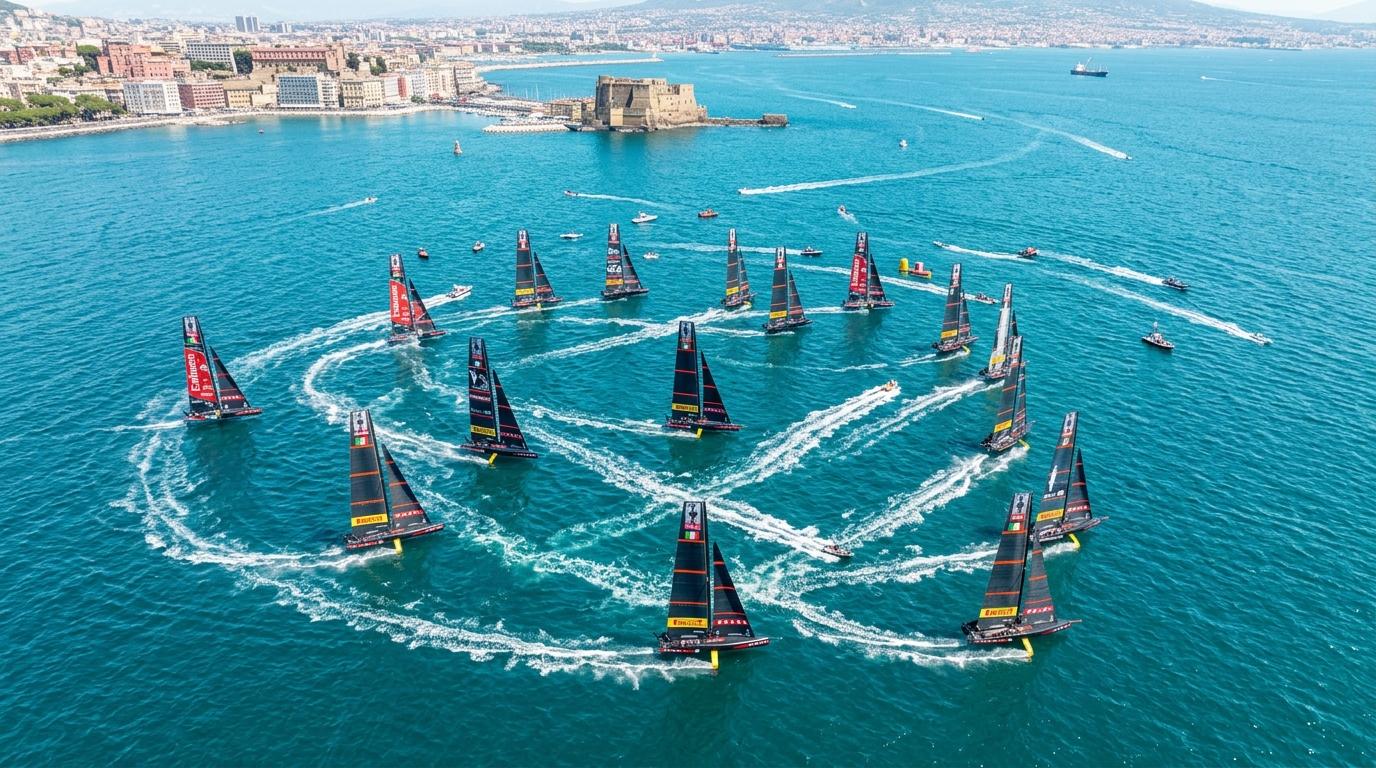
⛵ America's Cup Guide for Beginners: Rules, Fleet Races, and Match Races
The America’s Cup is the oldest sports trophy in the world, but looking at modern boats — the foiling monohulls of the AC40 or AC75 class — it feels like watching a Formula 1 race flying over the sea. With vessels speeding at over 50 knots (nearly 100 km/h) lifted out of the water, understanding what is happening on the race course can seem like a daunting task for non-experts.
In reality, behind the aerospace technology and onboard computers, the fundamental rules of the America's Cup are based on the age-old principles of sailing, transformed into a ruthless tactical duel.
In this QueryBoat guide, we explain in a simple yet rigorous way how the races work, how to read the race course, and the crucial difference between Fleet Races and Match Races.
📐 1. The Race Course: A "Virtual Stadium" on the Sea
Unlike classic open-sea regattas, modern America's Cup races take place within a virtual rectangle delimited by GPS buoys (called marks).
🏁 The course (Windward/Leeward): The race develops along the wind axis. The boats start upwind towards a buoy positioned at the top (Windward Mark), round it, and jibe to head downwind (Leeward Mark). This circuit is repeated for a set number of laps (usually 4 or 6).
🚧 The Boundaries: The race course has strict electronic boundaries. If a boat exits the boundaries, the onboard computer immediately signals an infringement and a penalty is issued (the vessel must slow down, losing about 75 meters to its opponent).
🚦 2. The Start: The Most Spectacular and Crucial Moment
In sailing races, there is no starting line to sprint from a standstill. The boats arrive at the line already at maximum speed as the clock hits zero.
⏱️ The 2-Minute Countdown: A pre-start area is defined. Two minutes before the START, the boats enter the box and begin a true "high-speed dance" to position themselves optimally, try to cut off the opponent, and cross the exact starting line at the precise moment the timer hits zero.
💥 Gaining the upper hand: Crossing the line even half a second early means being disqualified or receiving a penalty; crossing it late means handing the opponent clean air and a huge tactical advantage.
⚔️ 3. The Two Race Formats: Fleet Races vs Match Race
During America's Cup stages (such as the preliminary regattas), you will see two completely different race formats. Understanding the difference is key to enjoying the show:
🏆 A. Fleet Races
How it works: All the participating teams' vessels take to the water simultaneously on the same starting line.
The goal: To finish first by beating all the others.
The tactic: It is a race of pure speed, global strategy, and the ability to avoid boat traffic at critical points (such as rounding the buoys). Each finishing position earns points for the overall standings.
🤺 B. The Match Race (The One-on-One Duel)
How it works: Only TWO boats on the water. A true duel of the old school, with no third parties involved.
The goal: Setting a speed record doesn't matter; the ONLY goal is to cross the finish line before the direct opponent.
The tactic (Psychological Warfare): In a Match Race, right-of-way rules become an aggressive weapon. The boat in the leading position will try to "cover" the opponent's wind (robbing them of thrust) or push them beyond the race course boundaries to force an error.
⚖️ 4. Who has the right of way? The 3 Golden Rules in a nutshell
To understand why a boat suddenly changes course or why the umpires issue a penalty, just remember three basic right-of-way rules:
💨 Starboard tack beats Port tack: The boat receiving wind from the right side (starboard tack) always has the right of way over those receiving it from the left. Those on the left must tack or give way.
🌊 Leeward boat beats Windward boat: Between two boats sailing in the same direction, the one closer to the wind source (windward) must stay clear and give way to the one further from the wind (leeward).
🎯 Room at the Mark: When two boats arrive close to a buoy, the inside boat is entitled to space to safely perform the buoy-rounding maneuver.
🚩 5. How Penalties Work (The "Yellow and Blue Cards" of the sea)
In the modern America's Cup, there are no judges on land deciding at the end of the race. The Umpires monitor the race in real-time using high-precision GPS systems with millimeter accuracy.
🟡 Immediate penalty: If a boat commits an infringement (fails to yield right of way or exits the boundaries), a warning light appears on the crew's display.
📉 Penalty discharge: The penalized boat does not have to do a 360-degree turn as in the past, but must physically slow down until it loses 75 meters to its rival. The electronic system clears the penalty only when the gap has been recovered.