

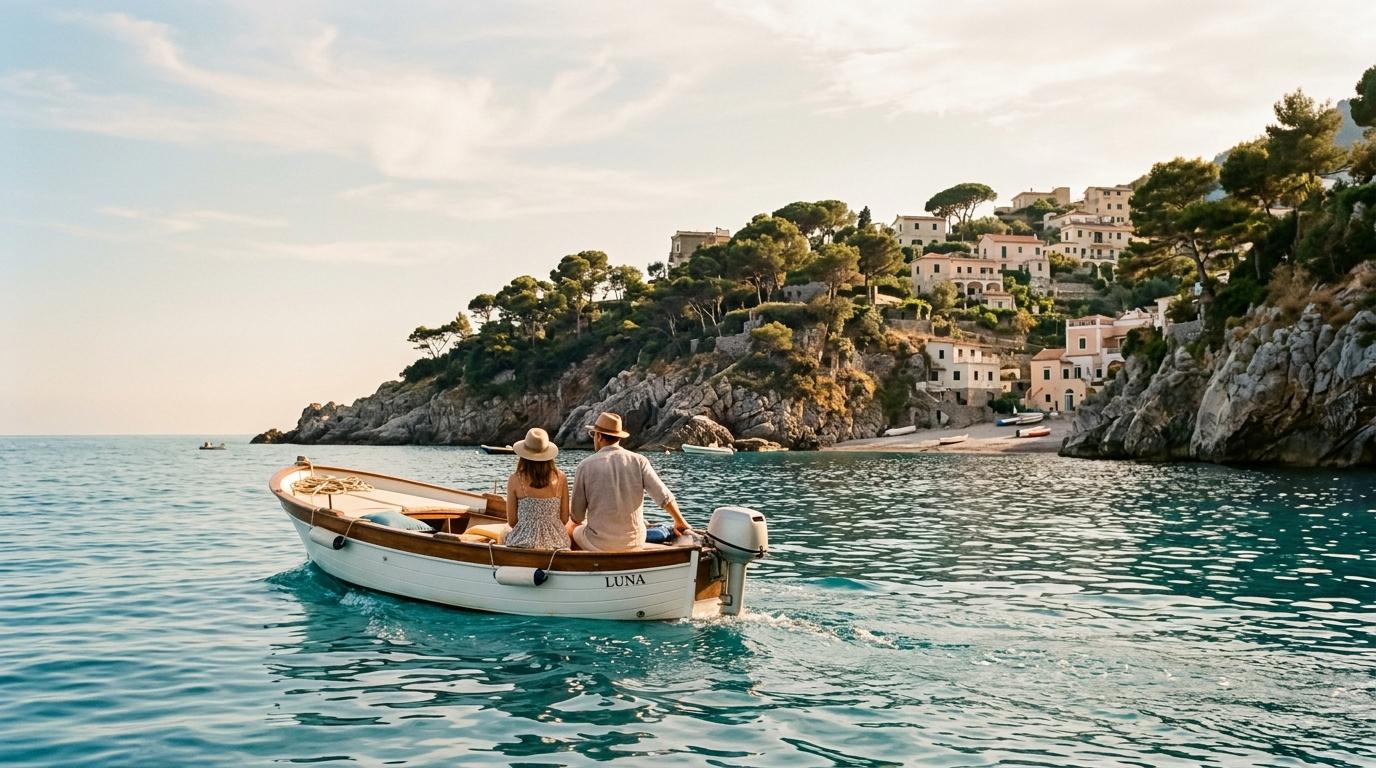
It is the question we are asked most often, and it is also the one about which there are many misconceptions: can you really rent a boat without a nautical licence? The answer is yes, under specific conditions established by the Recreational Boating Code. It is worth knowing them before stepping on board, because they are not just bureaucratic details: they define where you can go, with what vessel, and with whom.
⚓ The rule in a nutshell
You can operate a recreational craft without a nautical licence when both of these conditions are met:
- 🧭 you are sailing within six nautical miles of the nearest coast (about 11 kilometres);
- ⚙️ the engine does not exceed 30 kW, equal to 40.8 HP.
If either of these conditions is not met — a more powerful engine, or a route that takes you further offshore — a licence becomes mandatory. This is not a flexible threshold or a tolerated custom: it is the letter of Article 39 of the Code.
The six miles are measured from the nearest coast, not from the marina of departure. This is the clarification most often missed, and it completely changes the interpretation of an itinerary: by staying near the coast, you remain within the limits even after hours of sailing, while a stretch of open sea can take you outside the limit in just a few minutes.
🛥️ Which vessels are included, and which are not
Almost all boats used for a daily boat rental fall under the exemption: inflatable boats, small motorboats, and gozzo (traditional wooden boat). However, jet skis are always excluded, regardless of power: to operate a jet ski, you always need a licence, no matter what.
There are also engine displacement limits, in addition to the power limit. In practice, this is rarely discussed, because a vessel that respects the 40.8 HP limit will consequently respect the displacement limit — but it is good to know that there is more than one criterion.
🎂 The minimum age, which changes with the boat
The Code distinguishes based on the length of the vessel, and the required age changes accordingly:
| Type of vessel | Length | Minimum age |
|---|---|---|
| Imbarcazioni (Boats) | from 10 to 24 metres | 18 years |
| Natanti (Small craft) | up to 10 metres | 16 years |
| Sailing boats (over 4 m² of sail area) | up to 10 metres | 14 years |
Beware of a frequent misunderstanding: the age refers to who is at the helm, not to who is on board. Passengers can be of any age, provided that safety equipment requirements are met.
🆕 The 2026 update: the D1 licence
Until recently, there were only two scenarios: under 40.8 HP without a licence, or a full nautical licence. From 2026, a third possibility is added, the category D, type D1 licence, which bridges the gap between the two:
- allows engines up to 85 kW, equal to 115.6 HP;
- remains valid within six miles of the coast;
- is limited to daytime navigation;
- can be obtained from the age of 16.
It is a middle ground designed for those who sail regularly along the coast and find the 40.8 HP limit too restrictive, without needing to venture further offshore.
🚦 The rules that apply regardless
The absence of a licence does not mean an absence of rules. Two in particular should be kept in mind because they concern the most frequented stretches of sea:
- 🐌 Five knots within three hundred metres of the shore. This applies to everyone, without exception. It is the limit that protects swimmers, and it is also the one most frequently contested.
- 📋 Local ordinances may be more restrictive. Every Port Authority regulates its own waters: marine protected areas, launch corridors, restricted zones. The national rule is the minimum, not the final word.
🎒 What you need to bring with you
Much less than you might imagine. You need a valid identity document of the person who will be operating the vessel, to verify their age, and nothing else in terms of documentation.
The safety equipment — life jackets, lifebuoys, signalling devices, fire extinguisher — are on board, and it is the responsibility of the boat owner to ensure they are present and compliant for the intended navigation area. Your job is not to provide them, but to know where they are: ask before you leave, along with how the engine works and what to do in case of a breakdown. These five minutes can change your day if something goes wrong.
🌊 What this means, in practice, in the Gulf of Naples
Six miles from the nearest coast, in a gulf dotted with islands and headlands, are much more generous than the number suggests. By sailing along the coast, you can cross some of the most beautiful stretches of sea in the Mediterranean while remaining well within the limits: the coves of the Phlegraean Fields, the coastline between Miseno and Baia, and the headlands that enclose the gulf.
The practical advice is always the same, and it is not just a formality: agree on the itinerary with the boat owner before setting sail. They know their waters, they know which routes remain comfortably within the limits with that specific vessel and in those weather conditions, and they know where it is better to stop. A good boat owner will tell you this spontaneously.
❌ The three mistakes we see most often
- Measuring the six miles from the marina. They are measured from the nearest coast: it is a different thing, and almost always to your advantage.
- Taking for granted that a jet ski is like an inflatable boat. It never is: a licence is required regardless of power.
- Ignoring the weather because the boat is small. It is exactly the opposite: the less demanding the boat, the more the sea dictates the conditions. Checking the forecast is not excessive caution; it is part of navigation.
In summary
Sailing without a licence is perfectly legitimate, provided that two clear limits are respected — six miles from the coast and 40.8 HP — and the minimum age required for your vessel is met. From 2026, those who want a bit more power without obtaining a full licence can opt for the D1 licence.
On QueryBoat, you can find vessels that can be operated without a licence, with the engine power indicated on each listing: this way, the first check, the one that counts, is done even before you send a booking request.
The information provided refers to the Italian legislation on recreational boating in force at the date of publication. The ordinances of individual Port Authorities may introduce further limitations: in case of doubt, the boat owner and the local maritime authority remain the primary references.